How Early Life Shapes a Baby’s Skin Microbiome
Written by Jade Pizzato
Background
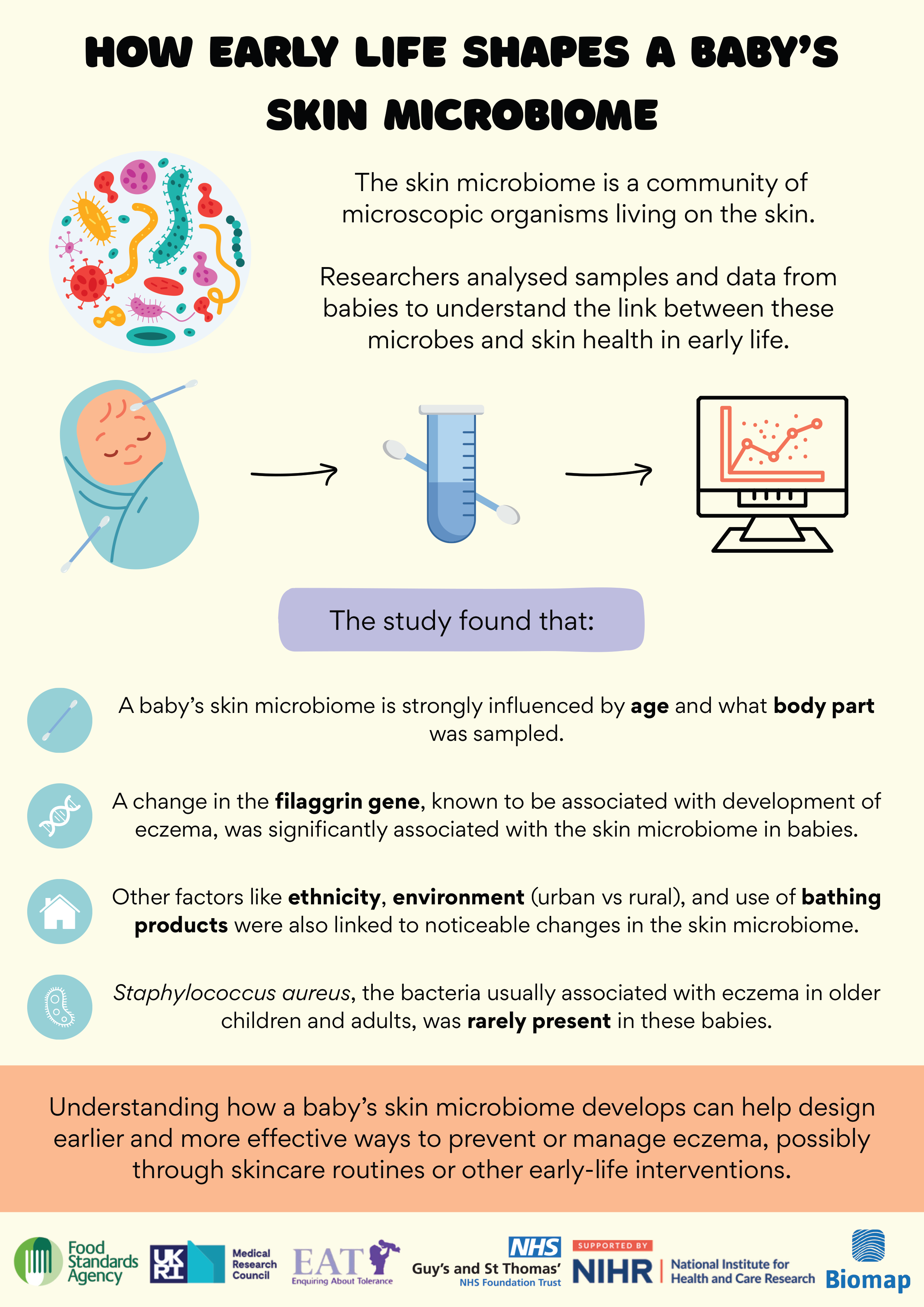
The Enquiring About Tolerance (EAT) study investigated whether early introduction of allergenic foods alongside breastfeeding reduced the risk of children developing food allergies and other allergic conditions (like eczema) by age three. As part of the EAT study, researchers followed infants from birth and collected skin swab samples from different body parts over time. They also gathered information on genetics, environment, skincare habits, and whether the child developed eczema. Using these data and samples, scientists looked at the skin microbiome – the community of microscopic organisms living on the skin – in babies during their first year of life. They wanted to understand what factors influence these microbes early on in life and how this might relate to skin health, including the development of eczema.
What did the research find?
- Almost one-third (30.4%) of babies enrolled in the EAT study at 3 months old had already developed eczema. By the time the children involved in the study turned 3 years old, nearly half (48%) of them had experienced active eczema at least once.
- The strongest influences on a baby’s skin microbiome were age and where on the body the sample was taken. Different areas of skin host different combinations of microbial species.
- Other factors, such as ethnicity, genetics, living environment (urban vs rural), and use of bathing products, were linked to smaller but noticeable changes in the skin microbiome.
- The filaggrin gene is the blueprint for creation of an important protein that provides structure and a strong skin barrier, which is essential for skin hydration and protection. A change in the filaggrin gene, known to be associated with development of eczema, was significantly associated with the skin microbiome in babies.
- There was no association between microbes found on skin and exposure to pets, antibiotic use, or bathing frequency.
- Changes in the types of bacteria present in the baby’s skin microbiome were linked to eczema and a weaker skin barrier, but the bacteria usually associated with eczema in older children and adults (Staphylococcus aureus) was rarely present in these very young infants.
Why is this important?
A baby’s skin microbiome changes rapidly in the first year of life and is shaped by growth, environment, and care practices. This research suggests that these early changes play a role in the development of eczema, which may start differently in early infancy compared to older children and adults. Understanding how a baby’s skin microbiome develops can help design earlier and more effective ways to prevent or manage eczema, possibly through skincare routines or other early-life interventions.
Related publication
Conor Broderick, Casper Sahl Poulsen, Mathis Hjort Hjelmsø, Tom Marrs, Suzana Radulovic, Kirsty Logan, Xuanji Li, Ziqi Wu, Søren Johannes Sørensen, Bouchra Ezzamouri, Helen Alexander, Nanna Fyhrquist, Harri Alenius, Madhumita Bhattacharyya, Avidan U Neumann, Gideon Lack, Michael Perkin, Klaus Bønnelykke, Jakob Stokholm, Carsten Flohr, Associations between early-life exposures and the infant skin microbiome, British Journal of Dermatology, 2026;, ljaf524, https://doi.org/10.1093/bjd/ljaf524